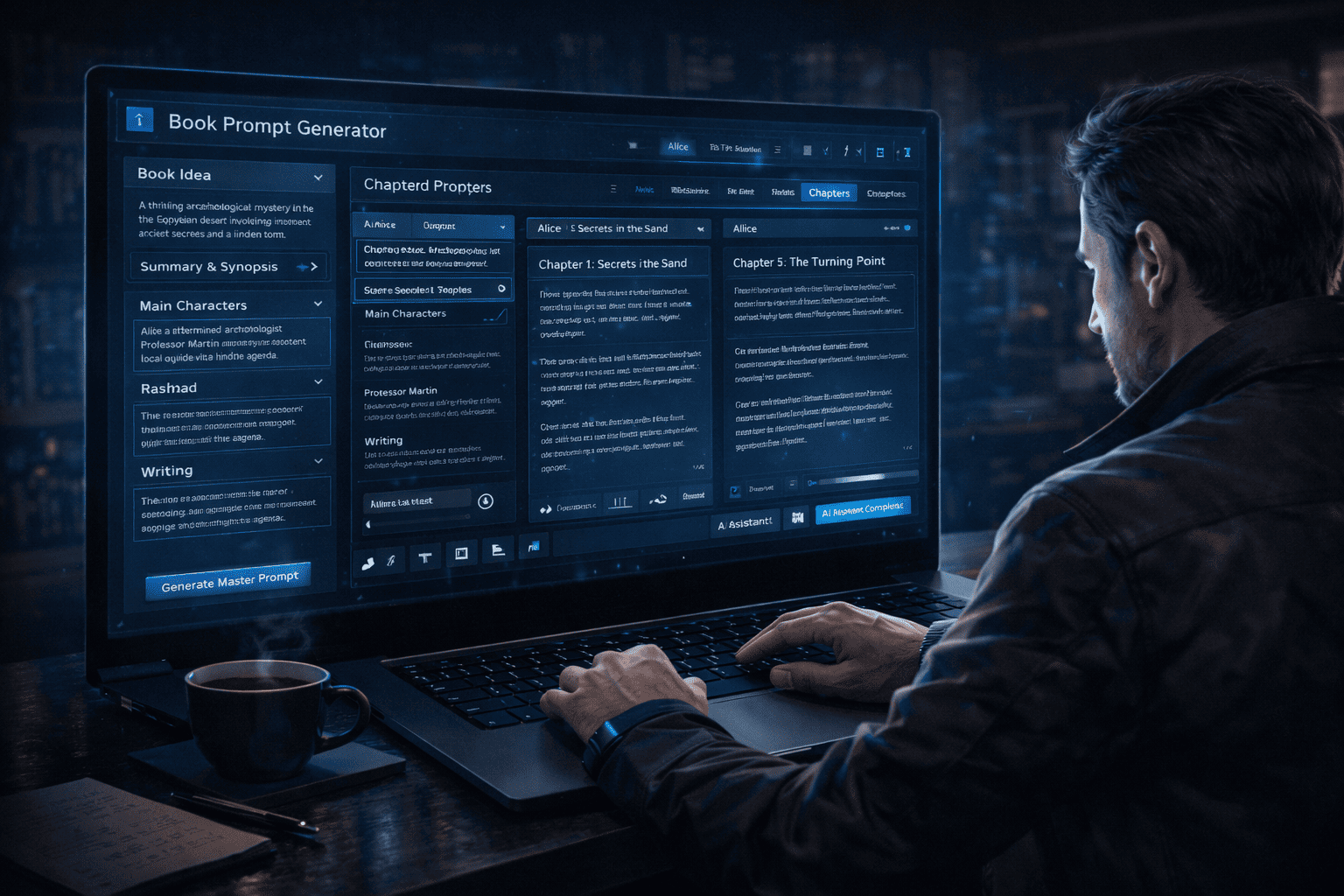
Artificial intelligence has transformed the way books are written. What once took months or years can now be achieved in weeks — sometimes days — when AI is used correctly.
This guide is a complete, up-to-date overview of book writing with AI. It covers workflows, prompt engineering, fiction and non-fiction use cases, publishing rules, and the tools professional authors rely on.
If you’re new to AI-assisted writing, this article is your starting point.
Explore the full blog: Aignition Agency Blog
What Does “Book Writing with AI” Really Mean?
Book writing with AI does not mean pressing a button and receiving a finished novel.
In practice, it means:
- Using AI to generate structured drafts
- Directing output with prompts and constraints
- Maintaining human control over content and quality
- Editing and refining AI-generated text
AI acts as a co-writer and accelerator — not a replacement for the author.
Who Uses AI to Write Books?
AI-assisted book writing is used by:
- Self-publishing authors
- Entrepreneurs and coaches
- Educators and trainers
- Agencies and enterprises
- AI enthusiasts building content businesses
The common factor is the need for speed, structure, and scalability.
Types of Books You Can Write with AI
AI supports a wide range of book formats.
Non-Fiction
- How-to guides
- Business and productivity books
- Educational manuals
- Thought leadership books
Fiction
- Novels and novellas
- Book series and sagas
- Romance, fantasy, sci-fi, thrillers
Related guides:
Genres & Use Cases
The Core AI Book Writing Workflow
Professional AI-assisted authors follow a repeatable workflow:
- Book concept & audience definition
- Detailed outline creation
- Prompt engineering & constraints
- Chapter-by-chapter drafting
- Editing and quality control
- Formatting and publishing
This process ensures consistency and avoids common AI pitfalls.
Deep dive: Prompt Engineering for Books
Example: Book Concept Prompt
Create a book concept for a complete book.

BOOK TYPE:
TARGET READER:
PROBLEM OR DESIRE:
UNIQUE ANGLE:
EXPECTED OUTCOME FOR READER:

OUTPUT:
- One-paragraph premise
- Ideal reader profile
- Core promise of the book
Why Prompt Engineering Is Essential
AI output quality depends on prompt quality.
Prompt engineering helps:
- Reduce repetition
- Maintain tone and voice
- Keep chapters aligned with the outline
- Improve factual and narrative consistency
Without structured prompts, long-form AI writing breaks down quickly.
Editing AI-Generated Books
Editing is non-negotiable.
AI should never publish raw output. Instead, authors use AI for assisted editing.
Editing Prompt Example
Review this chapter for clarity, repetition, tone consistency, and structure.
Suggest improvements and rewrite where necessary while preserving meaning.
Human judgement remains essential at this stage.
Publishing AI-Written Books
Most major platforms allow AI-assisted books.
Amazon KDP, for example, requires disclosure during upload but does not prohibit AI usage.
Publishing guide:
Publishing & Monetisation
Common Mistakes in AI Book Writing
- Using one massive prompt
- Skipping outlines
- Ignoring consistency rules
- Publishing unedited drafts
- Over-relying on generic AI tools
A structured workflow prevents all of these.
Tools for Book Writing with AI
While generic AI chats can help, dedicated tools offer better results for long-form writing.
A specialised book prompt generator provides:
- Reusable prompt templates
- Chapter-level control
- Continuity management
- Faster drafting
Recommended tool:
Prompt Constructor Pro (Windows)
Recommended Internal Links
- Blog Home
- Guides & Tutorials
- Prompt Engineering for Books
- Case Studies & Examples
- Enterprise AI Writing
Frequently Asked Questions
Can AI write an entire book?
Yes, with structured prompts and human editing. AI excels at drafting but requires guidance.
Is book writing with AI legal?
Yes. Most platforms allow AI-assisted content with disclosure.
Is AI better for fiction or non-fiction?
Both. Fiction benefits from scene generation, while non-fiction benefits from structured explanations.
Do I need coding skills to write books with AI?
No. Prompt-based tools are designed for authors, not developers.
What is the best AI tool for writing books?
Dedicated book prompt generators outperform generic AI chats for long-form writing.