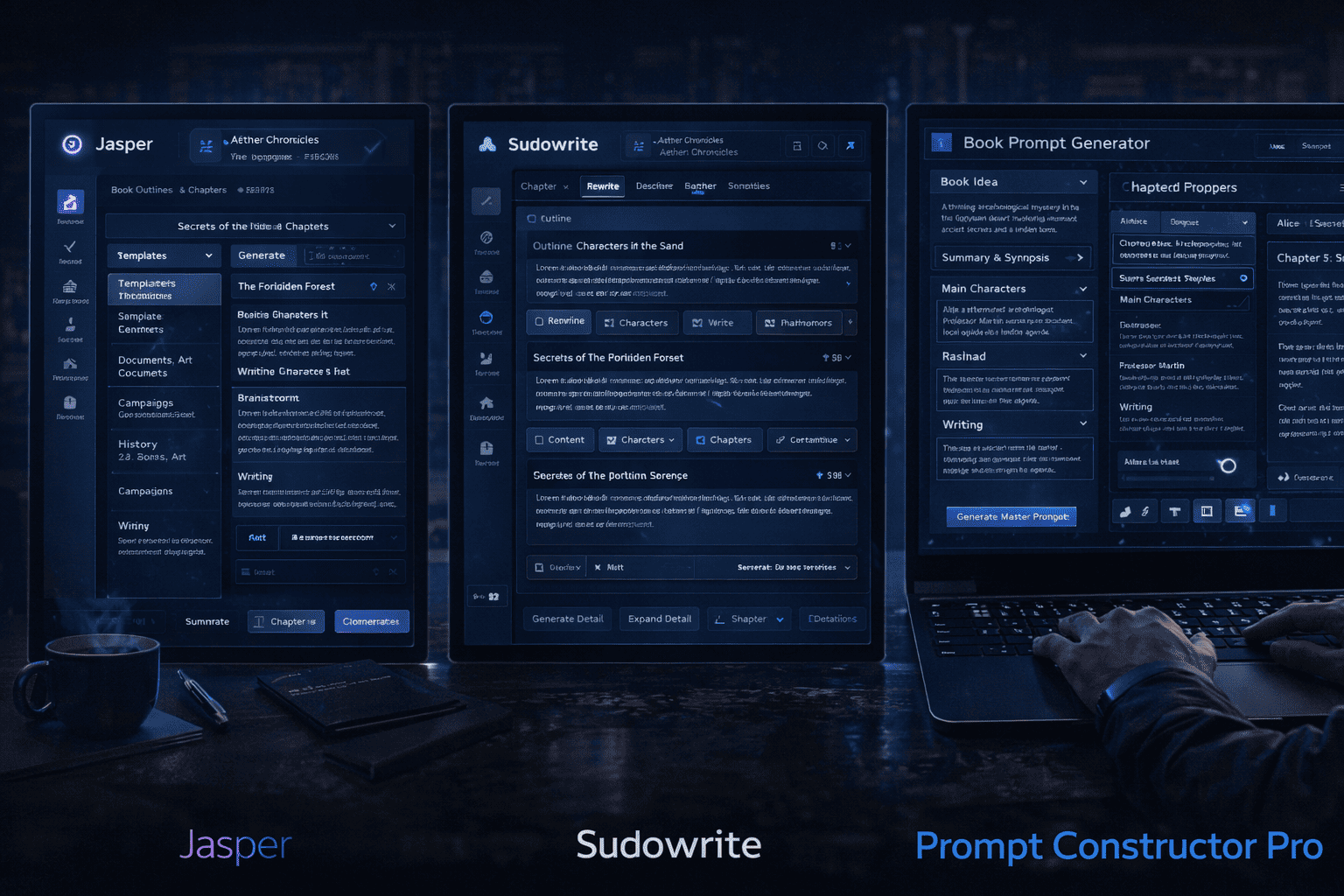
If you’ve tried writing long-form content with AI, you already know the truth: AI can be impressive for short pieces, but it often struggles to stay consistent across a full book.
The fix isn’t “a better model” or “more creativity”. The fix is prompt engineering — a structured way to instruct AI so it can produce coherent chapters, maintain tone, and follow an outline without drifting.
This guide gives you a practical framework to engineer prompts for complete books (fiction or non-fiction), including templates you can copy and paste.
Recommended reading (internal): Guides & Tutorials · Blog Home
What Is Prompt Engineering (for Book Writing)?
Prompt engineering is the process of designing instructions that guide an AI model towards a specific output. For book writing, that means:
- Reducing randomness and repetition
- Maintaining a stable voice across chapters
- Keeping continuity (characters, facts, timelines)
- Producing structured, publishable draft sections
In other words: you’re not asking AI to “write a book”. You’re directing AI to write your book, step by step, using prompts as a system.
Why Generic AI Chats Fail at Full Books
Generic chat tools are brilliant for ideation, but long-form book projects tend to fail because of:
- Context drift: the AI forgets earlier decisions and changes details later.
- Style inconsistency: tone and pacing vary between chapters.
- Outline leakage: chapters jump ahead or repeat points.
- Factual wobble: non-fiction content can become vague or inaccurate.
That’s why serious authors and creators use a structured prompt workflow (or a dedicated prompt tool) rather than “one prompt to rule them all”.
Download the dedicated prompt tool:
Download Prompt Constructor Pro
The Full-Book Prompt Engineering Framework (7 Layers)
For reliable long-form output, engineer prompts in layers. Here’s the framework:
- Project Brief (what the book is, who it’s for)
- Constraints (word counts, chapter rules, factual rules)
- Voice & Style Sheet (tone, reading level, rhythm)
- Outline (chapters + goals + deliverables)
- Continuity Memory (characters/facts ledger)
- Chapter Execution Prompts (repeatable templates)
- Quality Gates (self-check + rewrite loops)
Below you’ll get copy/paste prompts for every layer.
Layer 1: The Project Brief Prompt
This sets the foundation. Keep it clear and specific.
Project Brief Prompt (Copy/Paste)
You are an expert book co-writer and developmental editor.
Create a project brief for a complete book.

BOOK TYPE: [Fiction / Non-fiction]
GENRE/TOPIC: [e.g., Productivity for entrepreneurs / Fantasy romance]
TARGET READER: [who is it for]
GOAL: [what transformation or experience the reader gets]
UNIQUE ANGLE: [what makes it different]
LENGTH: [approx word count, e.g., 40,000–60,000]
OUTPUT:
1) One-paragraph premise
2) Audience profile
3) Key promises (bullet list)
4) Tone/voice summary
5) Success criteria
Tip: Save the final brief in a document. You’ll reuse it for every chapter prompt.
Layer 2: Constraints Prompt (Rules That Prevent Chaos)
AI performs better when you define constraints upfront. Examples:
- Each chapter must have: hook → main teaching/story beats → takeaway
- No repeated metaphors or filler lines
- Use UK English spelling and punctuation
- Keep names, dates, and key facts consistent
Constraints Prompt (Copy/Paste)
These are non-negotiable writing constraints for this book:

- Use UK English spelling and punctuation.
- Avoid repetition: do not re-explain the same point unless adding a new example or deeper layer.
- Keep a consistent voice and pacing across chapters.
- If non-fiction: prefer clear, practical explanations with examples and steps.
- If fiction: maintain continuity (names, timeline, setting rules).
- Do not invent “facts” without signalling uncertainty; if unsure, suggest a placeholder for later verification.
- End each chapter with a short recap and a forward teaser.

Confirm you understand these constraints and restate them briefly.
Layer 3: Voice & Style Sheet (So the Book Sounds Like One Author)
A style sheet is your “voice contract”. Define:
- Reading level (e.g., accessible, professional)
- Sentence rhythm (short + punchy vs long-form narrative)
- Formatting style (subheadings, bullet lists, summaries)
- Forbidden habits (overly poetic intros, generic clichés)
Voice & Style Sheet Prompt (Copy/Paste)
Create a one-page voice and style sheet for this book.

Include:
- Voice: [e.g., practical, confident, friendly, no fluff]
- Reading level: [e.g., accessible for beginners]
- Sentence rhythm rules
- Formatting rules (headings, bullets, recaps)
- “Do not do” list (clichés, filler, overuse of adverbs, etc.)
- Example paragraph in the correct voice
Internal link suggestion: Readers who want beginner workflow should also read: Guides & Tutorials
Layer 4: Outline Engineering (The Backbone of the Book)
Most AI-written books fail because the outline is weak. A strong outline must specify:
- Chapter objective
- Key points or story beats
- Examples, exercises, or scenes
- Deliverable (what the reader learns/gets)
Outline Prompt (Copy/Paste)
Create a complete book outline.

Requirements:
- 10–14 chapters (adjust if needed)
- For each chapter include:
  1) Chapter title
  2) Objective (one sentence)
  3) Key sections (bullets)
  4) Example/story/exercise to include
  5) End-of-chapter takeaway
- Ensure a logical progression from beginner to advanced
- Avoid overlap between chapters
- Keep it aligned with the project brief
Layer 5: Continuity Memory (The Secret to Consistency)
Continuity memory is a “ledger” that stores stable facts. This is essential for:
- Fiction: characters, world rules, timeline
- Non-fiction: definitions, frameworks, terminology, examples
Continuity Ledger Prompt (Copy/Paste)
Create a Continuity Ledger for this book.

Include:
- Key terms and definitions (non-fiction) OR characters/world rules (fiction)
- Fixed decisions: names, settings, timelines, recurring examples
- A “do not contradict” list
- A “reference checklist” to use at the end of every chapter

Format it as a clean, skimmable list.
Internal link suggestion: Genre-specific continuity tips: Genres & Use Cases
Layer 6: Chapter Execution Template (Reusable Prompt)
This is where the real execution happens. You define a single, reusable chapter-writing prompt and apply it consistently across the entire book, changing only the chapter-specific inputs.
Reusable Chapter Writing Prompt (Copy & Paste)
You are writing Chapter [X] of the book.

PROJECT BRIEF:
[paste the complete book brief]

VOICE & STYLE SHEET:
[paste voice, tone, POV, and stylistic rules]

CONSTRAINTS:
[paste structural and editorial constraints]

CONTINUITY LEDGER:
[paste characters, timelines, rules, facts]

CHAPTER OUTLINE:
- Title: [chapter title]
- Objective: [what this chapter must achieve]
- Sections:
  • [section 1]
  • [section 2]
  • [section 3]
- Example / Exercise:
  [practical example or exercise]
- Takeaway:
  [what the reader must understand]

WRITE THE CHAPTER:
- Open with a strong hook (no meta commentary)
- Use clear H2 and H3 headings
- Keep sections concise and practical
- Include the example or exercise naturally
- End with:
  1) Key takeaways (bullet points)
  2) A teaser for the next chapter
This reusable template is the difference between random AI-generated text and a coherent, professional book draft.
Layer 7: Quality Gates (Self-Editing Prompts)
After generating a chapter, run a quality pass. This improves clarity, reduces repetition, and catches drift.
Quality Gate Prompt (Copy/Paste)
Quality review this chapter.

Checklist:
1) Does it match the chapter objective?
2) Any repetition or filler to remove?
3) Is the voice consistent with the style sheet?
4) Any contradictions with the continuity ledger?
5) Is the structure clean (headings, flow, recap)?
6) Give 5 specific improvements.

Then rewrite the chapter applying the improvements, keeping the same meaning but improving clarity and flow.
Example: Prompt Engineering for Fiction vs Non-Fiction
Fiction: Add Story Rules
- POV rules (first person / third limited)
- Dialogue ratio
- Conflict and stakes per chapter
Non-Fiction: Add Evidence Rules
- Define terms the first time you use them
- Provide examples and steps
- Use action-focused summaries
If your readers are building publishable work, link them onwards:
Recommended Internal Links (User Experience & SEO)
Primary CTA (soft):
If you want a ready-made prompt system for writing full books, download the tool:
Prompt Constructor Pro Setup (Windows)
About the product:
Aignition Agency – Official Site
Frequently Asked Questions
What is the best prompt for writing a full book with AI?
The best prompt is not a single prompt. It’s a structured sequence: brief + constraints + outline + chapter template + quality gates.
Why does AI repeat itself in long-form writing?
Because the prompt lacks constraints and the model fills space. Quality gate prompts and a style sheet reduce repetition dramatically.
Do I need different prompts for fiction and non-fiction?
Yes. Fiction needs story rules (POV, pacing, continuity). Non-fiction needs clarity rules (definitions, steps, examples, accuracy).
How do I keep AI consistent across chapters?
Use a continuity ledger and paste it into every chapter prompt. Also reuse the same chapter template and style sheet.
Can a prompt generator tool help more than ChatGPT alone?
Yes. Dedicated tools provide structured book workflows and prompt templates designed specifically for long-form writing.